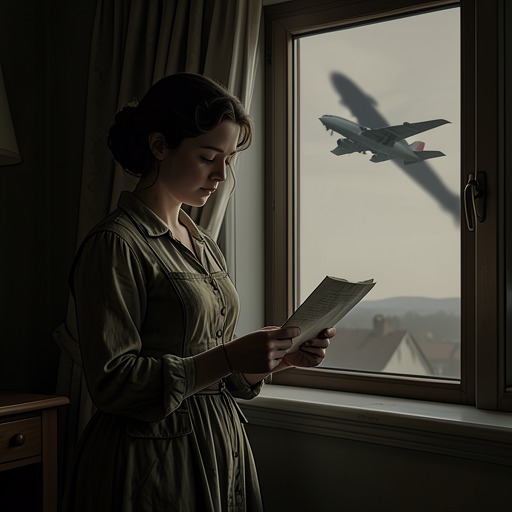
Supermarine Spitfire
Pamela's WarThe Supermarine Spitfire is remembered not merely as a wartime fighter aircraft but as the material form of an intimate message. Its distinctive engine announces the presence of the man the narrator loves, while its height, speed, and weaponry make the encounter inseparable from the dangers of wartime service. The aircraft’s appearance briefly transforms the sky into a private channel of communication, only for that exhilaration to be shadowed by the narrator’s later realization that she will never see him again.
Appearance and Recognition
On the Sunday after the narrator and the young airman promise to take great care of themselves, she hears a plane overhead and identifies it immediately as a Supermarine Spitfire. Its engine is unmistakable to her. Unlike the bomber involved in the earlier incident, the fighter makes considerably less noise; it is smaller, flies much higher, and carries only one person. These physical distinctions make recognition instantaneous rather than uncertain: the machine’s sound and silhouette are enough for her to know what she is hearing and seeing.
The aircraft is described through the dangerous intimacy of its design. Its controls incorporate the gun trigger, making the fighter a flying weapon as well as a vehicle. The narrator imagines the pilot as a brave young hero operating a single-seater that carries its violence into the sky. The Spitfire therefore joins technical detail to emotional perception: its machinery is precise, armed, and built for combat, yet its presence is experienced by the narrator as a personal visitation.
A Message from the Sky
The narrator knows at once who is at the controls and understands the flight as a message directed to her. The plane loops the loop high above her, turning an ordinary passage overhead into a deliberate gesture. No spoken exchange is possible, but the aircraft’s movement performs the communication: the airman has found a way to make himself present while remaining separated from her by height, distance, military duty, and danger.
The narrator answers with equal inventiveness. Remembering the consequences of the earlier encounter with the Sterling bomber, she decides that her acknowledgement must be more discreet. Instead of making an obvious display, she hurries upstairs and waves a tea towel from one of the windows. The humble domestic object becomes part of the signalling system. Against the fighter’s guns, engine, and heroic aerial manoeuvre, the tea towel offers a small, improvised reply from the household below; together, the two objects establish a fragile bridge between military action and private affection.
Excitement and Foreboding
The flight initially produces intense excitement. The narrator greets the Spitfire as the sign of her brave young hero’s presence, and the aircraft seems to give physical shape to romantic exhilaration. Yet the scene contains a decisive reversal. Although she recognizes the man in the cockpit and responds to his message, she cannot know that this is the last time she will see him. The machine that carries him close enough to be recognized also carries him beyond her reach.
The narrative makes the later loss felt through a gap between knowledge and experience. At the moment of the flight, the narrator reads the Spitfire as reassurance: he is alive, active, and thinking of her. Only afterward does the scene acquire its final meaning. Her question about how she could guess that she would never see him again exposes the cruelty of hindsight without claiming that the aircraft itself causes the loss. The Spitfire becomes the object through which a joyful sign is preserved while the future disaster remains concealed.
Narrative Significance
The Supermarine Spitfire concentrates the book’s wartime contrast between everyday domestic life and aerial violence. The fighter is a machine designed for combat, with a gun trigger built into its controls, but the narrator remembers it through a tea towel waved from an upstairs window. The juxtaposition does not erase the aircraft’s danger; instead, it shows how military technology enters private life through sound, sight, anticipation, and grief.
Its role is also shaped by omission. The account does not describe the airman’s subsequent fate in the same scene, nor does it provide a direct explanation for the narrator’s later certainty of loss. Instead, the Spitfire’s looping flight and the discreet wave remain suspended as the last complete exchange. The aircraft’s power lies partly in this unresolved interval: it is simultaneously a fighter, a messenger, and a memorial image, preserving the brightness of contact at the exact point where wartime separation begins.